Understanding interfaces and transport across scales.
We study how dynamic interfaces and confined environments control transport and transformation. Materials synthesis, electrochemistry, and operando synchrotron X-rays are integrated throughout our research.
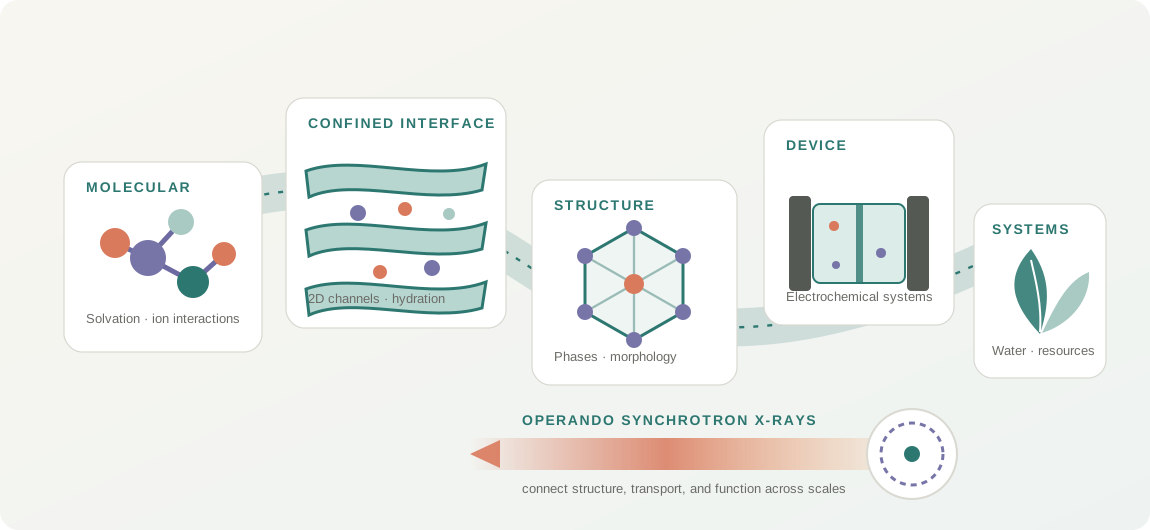
Electrochemical technologies can convert renewable electricity into chemical transformations that are important for a more sustainable carbon and nitrogen cycle. We use carbon dioxide electroreduction and ammonia oxidation as representative reactions: CO2 reduction provides a route to transform captured carbon into useful chemicals and fuels, while ammonia oxidation offers pathways for nitrogen management, pollutant removal, and value-added electrochemical conversion. In both systems, reaction selectivity and efficiency are governed by dynamic interfaces where catalysts, electrolytes, dissolved species, gases, and solid products continuously reorganize.
These interfacial processes become even more important when electrochemical devices operate with dynamic electricity supplied by intermittent renewable sources. Changes in current, potential, startup, shutdown, and load can continuously alter local mass transport, gas and liquid distributions, catalyst structure, and phase behavior. We therefore combine purpose-built electrochemical cells with operando synchrotron radiography and diffraction to directly observe how working interfaces respond to changing operating conditions and to connect those changes with performance, selectivity, and stability.
One platform, different interfacial chemistries.
We adapt a common electrochemical architecture to study transformations at opposing interfaces, including CO2 electroreduction and ammonia oxidation. The emphasis is not a single device chemistry, but the dynamic interfacial processes shared across electrochemical systems.
Seeing inside a working electrochemical device.
Our synchrotron-compatible cells are designed so that diffraction and transmission imaging can probe the same operating device. This provides complementary views of interfacial structure, phase evolution, and transport while current is flowing.
Reserved for your uploaded operando platform figure.
Gas accumulation and liquid redistribution.
Time-resolved radiography tracks changes in X-ray transmission as gas accumulates and liquid is displaced inside porous components and flow channels. The contrast evolution provides a direct view of how the internal multiphase environment changes during operation.
Operando radiography image
Phase evolution under operating current.
Two-dimensional diffraction patterns reveal changes in crystalline phases during operation, including the appearance of salt diffraction features at elevated current density.
Operando diffraction patterns
Two-dimensional membranes create angstrom- to nanometer-scale channels in which water, ions, and surface chemistry interact strongly. We design and assemble layered materials such as MXenes and tune their interlayer environment through composition and intercalation. The central goal is to understand how local water organization, ion hydration, and confinement determine which species enter, move through, and leave these channels.
Transport cannot be understood from nanochannel size alone. Defects, swelling, tortuosity, sheet alignment, and mesoscale morphology create additional pathways that can dominate membrane performance. We therefore connect molecular interactions to membrane structure across length scales using diffraction and scattering for interlayer structure and orientational order, together with three-dimensional FIB-SEM and X-ray nanotomography for pores, defects, and transport heterogeneity. This multiscale picture guides the design of selective membranes for water treatment, separations, and sustainable ion-management technologies.
From local interactions to selective ion transport.
Water organization, ion hydration, surface chemistry, and interlayer spacing collectively determine transport through angstrom- and nanometer-scale channels. We use these relationships to identify how selectivity is created inside the confined membrane environment.
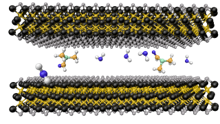
Following transport through layered MXene channels.
Layered MXene membranes create nanoscale pathways whose local chemistry and structure evolve with hydration and ion intercalation. The visualization connects molecular-scale confinement with the organization of stacked sheets and the transport pathways that emerge through the membrane.
Resolving chemistry at hydrated interfaces.
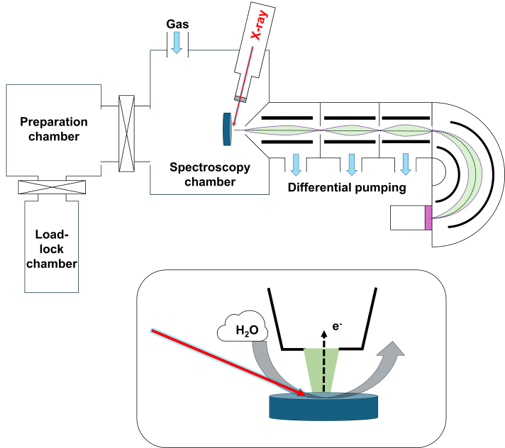
Operando and ambient-pressure spectroscopy complements scattering and three-dimensional imaging by probing chemical states and interfacial environments under realistic conditions. Together, these measurements connect local chemistry with structural evolution and transport.